
How to Cite
Abstract
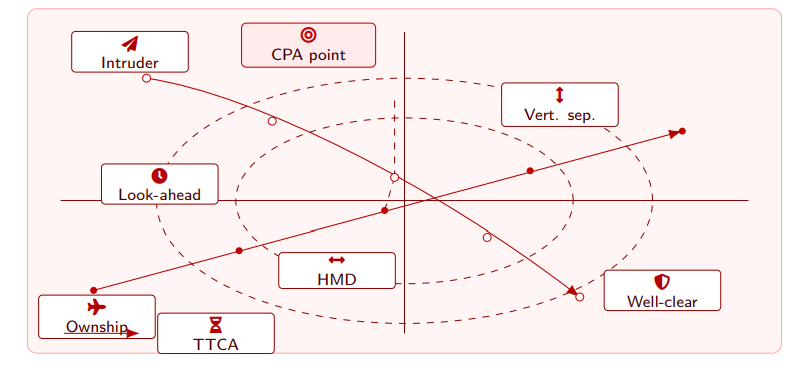
Unmanned aircraft detect and avoid systems require reliable prediction of future separation because unsafe encounter states may develop before a remote pilot or autonomy stack can respond. Hazard prediction is difficult when the intruder aircraft changes heading, speed, or vertical rate while the ownship receives only noisy relative measurements. This paper reports an empirical Monte Carlo study of a distributionally calibrated multiple model learning method for real time hazard state prediction in three dimensional unmanned aircraft encounters. The proposed method combines an interacting multiple model state estimator with a supervised residual learning layer trained to correct future horizontal miss distance, time to closest approach, vertical separation, and loss of well clear probability. A simulated data set of 260,000 encounters was generated with randomized geometry, maneuver modes, turn rates, acceleration levels, climb rates, and sensor noise regimes. The model was evaluated on held out encounters using deterministic error metrics, binary classification metrics, probabilistic calibration scores, ablation analysis, and paired statistical tests. Under medium measurement noise at a 35 s look ahead horizon, the proposed method reduced horizontal miss distance mean absolute error by 58.4\% relative to linear extrapolation and by 32.6\% relative to an uncorrected interacting multiple model predictor. Loss of well clear F1 score improved from 0.654 for linear extrapolation and 0.746 for the uncorrected interacting multiple model predictor to 0.821. Nominal 90\% predictive intervals achieved 88.9\% empirical coverage. The results show measurable improvement in simulated maneuvering encounters while preserving a physically interpretable estimation backbone.
References

This work is licensed under a Creative Commons Attribution-NonCommercial-NoDerivatives 4.0 International License.
Copyright (c) 2026 authors