
How to Cite
Abstract
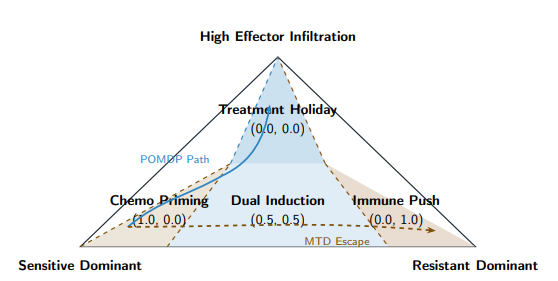
Optimizing the temporal sequencing and dosage of combination chemotherapy and immune checkpoint blockade presents a formidable clinical challenge due to the hidden, non-linear evolutionary dynamics of malignant cell populations and host immune effectors. Standard clinical protocols rely almost universally on empirical maximum tolerated dose (MTD) fractionation or rigid metronomic cycles that overlook individual phenotypic heterogeneity and fail to adapt as tumor clones develop treatment-induced resistance. Moreover, clinicians rarely observe true underlying tumor burdens or microenvironmental immune activation states directly; clinical decisions are guided instead by infrequent, noise-corrupted radiological scans and delayed circulating blood biomarkers. In this paper, we formulate dynamic chemo-immunotherapy scheduling as a Partially Observable Markov Decision Process (POMDP) under continuousstate, discrete-action, and asynchronous partial observation constraints. The latent physiological state captures active tumor volumes, cytotoxic T lymphocyte densities, regulatory T cell suppression levels, and cumulative drug-induced organ-at-risk (OAR) toxicities. We develop a Point-Based Value Iteration (PBVI) algorithm equipped with belief-simplex sampling and particle-filtered Bayesian state estimation to compute adaptive, patient-specific dosing policies. The multi-objective reward structure penalizes malignant clone progression while enforcing rigorous probabilistic safety constraints against life-threatening neutropenia and cardiotoxicity. Evaluated across an in silico cohort of 1,000 heterogeneous virtual cancer patients, our POMDP policy achieves a 28.4% increase in twoyear progression-free survival relative to fixed MTD schedules while reducing cumulative chemotherapeutic toxicity by 39.1%. The computed policies discover counterintuitive, highly effective therapeutic paradigms, such as intermittent immune-priming micro-dosing and planned treatment holidays that prevent chemo-refractory clonal selection. These findings establish partially observable decisiontheoretic frameworks as a powerful paradigm for closed-loop, personalized therapeutic optimization in precision oncology.
References

This work is licensed under a Creative Commons Attribution-NonCommercial-NoDerivatives 4.0 International License.
Copyright (c) 2025 authors